
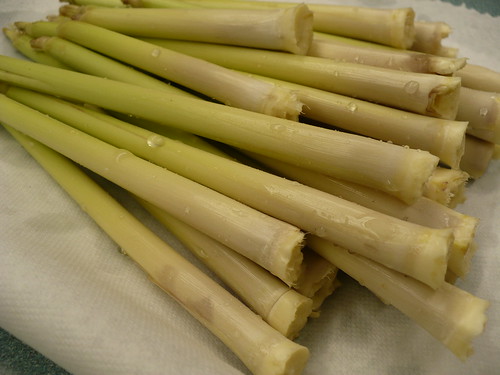
 We had lemongrass in the Demo Garden back in 2010, as part of our Asian Garden. For some reason, the only pictures I have of it were at the harvest stage. It was a really pretty plant! Lemongrass is a fountain-shaped grass that is valued in Southeast Asian cooking for its lemon flavor and scent. It is hardy to zone 8, so it is an annual plant for us in Kansas. However, it has plenty of time and warm weather to develop good quality stalks during our summer growing season.
As a tropical plant, lemongrass should be started indoors or in a greenhouse, and then transplanted outside after all danger of frost is past and the soil is quite warm. I would expect mid-May to be a good average planting date for lemongrass in south central Kansas. Once the weather turns hot and humid, it will grow quickly. Lemongrass plants can easily reach a diameter of 3 feet in one growing season in Kansas, so it is wise to space them at least 2-3 feet apart when planting.
If desired, at the end of the growing season, a few stalks can be harvested and potted indoors or in the greenhouse to provide propagation stock for the next season.
There are two main types of lemongrass, East Indian Lemongrass and West Indian Lemongrass. Both can be grown and used for cooking and teas, although the West Indian Lemongrass has a better culinary value.
East Indian Lemongrass can be grown from seed. It does not have as thick of stalks or as strong a flavor as the West Indian, although the leaves can be used in teas or for flavorings.
West Indian Lemongrass has thicker stalks, yielding better for culinary uses. This type of lemongrass should be started from divisions of an existing plant or by rooting a stalk from a grocery story source. Each plant will produce up to 12 thick stalks, and will re-grow if cut near the ground. You can sometimes find seeds for West Indian Lemongrass, but it is hard to know what the quality of the plant will be until you try them.
We are not growing lemongrass in the Demo Garden this year, but my husband and I love Thai food, so we are going to grow a couple plants in our community garden plot. I wanted to make sure we got the West Indian Lemongrass (I think we had East Indian in the Demo Garden last time), so I went and bought a couple of stalks from the grocery store.
Like every good gardener, I did a Google search on propagating lemongrass from the stalks. It looks like everyone tries to start them in a jar of water, and then transplant them into soil after that. As a horticulturalist, I know that this is not usually an ideal scenario, because the roots that grow in the water are adapted to low-oxygen. It stresses the plant more to start in water and transplant than it does to start a cutting in perlite or even potting soil. I decided to forgo the perlite and just try planting the stalks in potting soil.
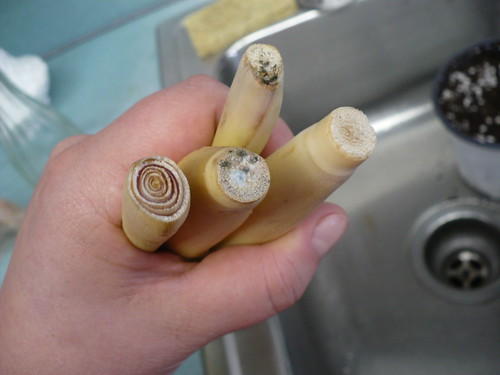 I wanted to make sure I bought stalks that still have the base intact. You can see that 3 of the 4 stalks do. 2 of them are even growing a little mold. I don’t think that should be a problem, but we’ll see. The 4th stalk has obviously been cut away. I’m skeptical that it will grow, since it seemed more dried out. We’ll watch and see what happens!
 I trimmed the stalks down so that they were only about 6 inches long. The tops are usually pretty dry and more likely to be dead.
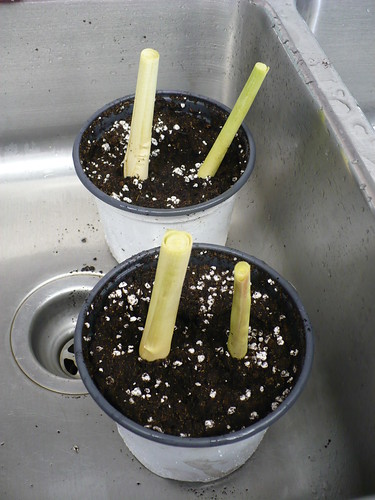 From there I just stuck them about 1 1/2 to 2 inches deep in moist potting soil and then put them under my lights. I’ll keep you posted on how they do.


 The Demo Garden Blog
Leave a reply to Shzilio Cancel reply