
Well, it’s happened. Every year tomatoes in Kansas suffer through one onslaught of disease, destruction, and disaster after another. (Okay, it’s not that bad, but I just couldn’t resist the alliteration!) Now that the weather has turned hot and humid, following a period of rainy weather, tomato diseases are starting to come out of the woodwork!
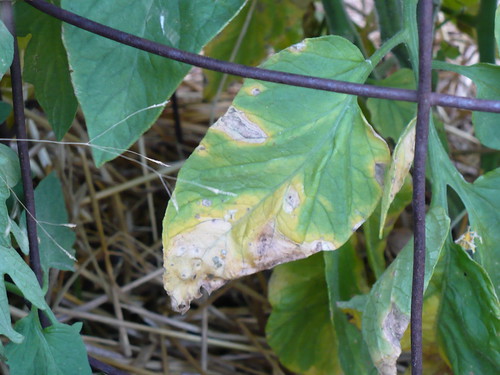 There’s our first sign of early blight, and a stellar sample it is, too! This is on our Brandywine tomato plant (dratted heirlooms!), near the bottom of the plant. Also of interest, notice that the leaf shape for this plant is more like a potato than a tomato. That’s because Brandywine is a “potato-leaf” type of tomato.
Typically we see either Early Blight or Septoria Leaf Spot (or both at the same time) show up right about now. The Early Blight is distinguished by the triangular yellowing with lesions that frequently have concentric circles in them. Septoria, on the other hand, is characterized by yellowing and lots of little black spots. In fact, the above leaf may have a few spots of Septoria on them as well.
Most gardeners first notice the bottom leaves of their tomato plants turning yellow and then brown. The diseases come from the soil, get splashed onto the lower leaves by rain or irrigation, and then work up the plants. We always try to mulch our tomatoes to prevent some of the disease problems. Drip irrigation, tomato cages, and appropriate spacing of the plants helps too. We usually try to pick off diseased leaves, and then the last resort is spraying. We haven’t sprayed anything yet. If you want to, you can use Chlorothalonil. Organic options include a copper-based fungicide, biologicals like Actinovate that are Bacillus subtilis or other bacteria that feed on fungus, or do nothing. Some years doing nothing works just fine, other years it can be disastrous. Of course, it’s hard to tell that before it’s too late!


 The Demo Garden Blog
Leave a reply to Susan Cancel reply