
 This is probably an ironic topic to be discussing, since we seem to be getting regularly deluged with far more rain than we really need, but I recently read an article in a trade magazine about correlating tomato flavor to the amount of water the plant receives.
Researchers did a study where they watered tomatoes at 0%, 25%, 50%, 75%, and 100% of evapotranspiration (ET). (Evapotranspiration is a fancy way of saying that they measured how much water was lost from the plants during each day. Just think how much that could be on a hot, windy, Kansas day!) So suppose that the plants lost 10 oz of water (I’m just making this up.). Some of the plants then received 0 oz of water, 2.5 oz, 5 oz, 7.5 oz, and 10 oz of water. This was done consistently from 1 week after transplanting until the end of the season in a cool coastal area and after flowering in a hotter, dryer location (like Kansas).
Some interesting things they observed from this study:
- Taste test panels preferred the flavor of fruit grown in the 0, 25, and 50% plots. Lab tests showed that these tomatoes were higher in sugars, soluble solids, and lycopene.
- Fruit color was good in all trials.
- Skin toughness was only reported in well-watered tomato fruit.
- Total yield was not significantly different between the trials.
- Marketable yields were lower in the most water stressed plots.
- The 0, 25, and 50% plots had fewer large and extra-large fruit, more insect and disease damaged fruit, more blossom end rot (duh!), and more sunburn.
So, tomatoes receiving less water are tastier and the lost yield isn’t significant in most cases. Interesting, wouldn’t you say?
Of course, I have to try something like this now, with my penchant for science projects. I don’t have a way to measure 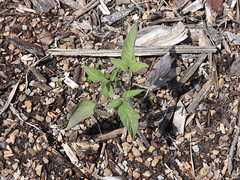 evapotranspiration, but we do have a garden on our grounds that is intended to be low-water. The garden is our “EarthKind” soils demonstration. The soil is heavy clay that has been amended with 3″ of expanded shale and 3″ of compost, and then mulched on top. This preparation is supposed to improve drainage in heavy clay soils and also prevent the need for frequent watering. (If that makes any sense, whatsoever.) Anyway, I planted 5 tomato plants out in our EarthKind Soils demo area (I think a Solar Fire, Brandymaster, Sweet Cluster, …and I forget the rest.) It will be interesting to see how much trouble we have with Blossom End Rot and also if they taste better than our sometimes-overwatered plants in the Demo Garden!


 The Demo Garden Blog
Leave a reply to Jennifer Cancel reply