
In addition to mint varieties, the “Cousins” in and around Bed #6 include a mixture of herbs such as oregano (Origanum vulgare), marjoram (Origanum majorana), rosemary (Salvia Rosmarinus), thyme (Thymus vulgaris), and sage (Salvia officinalis). While “mint” is not part of their name, they all belong to the Lamiaceae family, also known as the Mint family.
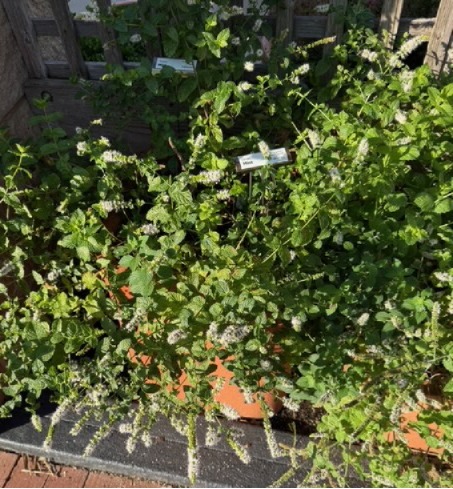
Other Cousins
Other mint-cousins include anise hyssop (Agastache foeniculum), lavender (Lavandula angustifolia), and sweet basil (Ocimum basilicum). Mint, and a selection of other herbs in the mint family, are described in the table, below.

Herb Uses
While this post features members of the mint family, these and many other herbs are found in gardens across Kansas. As described in Chapter 14 of the Kansas Garden Guide1, herbs are frequently grown for use in food preparation (culinary herbs); while others are used for teas, medicinal purposes, or ornamentally. In the Demo Garden, and in many home gardens, herbs are also grown to support insect and pollinator groups.

Herb Categories
Herbs are categorized as annual and as perennial or biennial. Tables within the Kansas Garden Guide show various varieties of herbs and their interesting characteristics1 (pages 128-132). A link to the online version of the Kansas Garden Guide is provided in the references for this post, please take a look.
Growing Herbs
If herbs are grown for culinary purposes, plants can be trimmed back when they begin to flower. While herb flowers attract pollinators, they should be removed when the blooms fade to promote healthy foliage growth. This is less important if the foliage is used for something other than flavoring foodstuff.


Harvesting & Storage
For herbs grown for their fresh foliage, approximately 3-6 inch stems should be harvested when the leaves are fully formed and stems are tender1. The uppermost tops of rosemary and thyme are clipped when plants are in full bloom. Note that herb harvest is best accomplished in early morning, before the sun is hot2.
Herbs grown to dry or freeze can be harvested just before buds open, when the flavor is at peak. Once harvested, clean herbs under cool running water and drain on paper towels2. To dry, herbs can be tied in loose bundles and hung in a well-ventilated room1 or dried using a dehydrator.

Harvesting herb seeds and blooms can be completed when the seed heads turn brown. Once cut from the plant the seed heads can be placed in a paper bag to allow the seeds to drop off, then transfer the seeds to a fine wire mesh or cheesecloth until completely dry2.
After herbs or seeds are completely dried, they can be stored in air-tight containers in a low-light, cool, dry area1,2.
Wishes from the Demo Garden
Whether growing herbs or other garden plants, we hope that you experience a plentiful harvest. We have a few more Demo Garden Blog entries planned, please check back soon.
References
- McMahon, R., Cloyd, R., et al. (2023). Kansas Garden Guide (pp. 123-132). K-State Research and Extension, Kansas State University, accessed August 29, 2025 at: https://bookstore.ksre.ksu.edu/pubs/kansas-garden-guide_S51.pdf
- Naeve, L. & Hayes, C. (2023). Growing, Harvesting, and Drying Herbs. Iowa State University Extension and Outreach, Iowa State University, accessed September 4, 2025 at: https://yardandgarden.extension.iastate.edu/how-to/growing-harvesting-and-drying-herbs
- Sources for the table: Mint and Selected Lamiaceae Family Members
- Mint: https://extension.illinois.edu/herbs/mint and
https://nutritionalgeography.faculty.ucdavis.edu/mint/ - Horehound: https://plants.ces.ncsu.edu/plants/marrubium-vulgare/ and
https://extension.usu.edu/yardandgarden/research/horehound-in-the-garden - Hyssop: https://plants.ces.ncsu.edu/plants/hyssopus-officinalis/
- Lemon Balm: https://plants.ces.ncsu.edu/plants/melissa-officinalis/
- Oregano: https://plants.ces.ncsu.edu/plants/origanum/ and
https://class.ucanr.edu/sites/default/files/2025-04/FactSheet_Herb_Oregano_2021.01.15.pdf - Thyme: https://plants.ces.ncsu.edu/plants/thymus-vulgaris/
- Mint: https://extension.illinois.edu/herbs/mint and
Contributing writer: Victoria Mosack, Sedgwick County Extension Master Gardener
Many Thanks!
While harvest continues in the Demo Garden, the 2025 season for the Plant-A-Row/ICT Food Rescue partnership has come to a close. As you consider plants for your 2026 garden beds, please include plans to donate extra produce next summer. Thank you to everyone who made contributions this year!
 The Demo Garden Blog
Leave a comment