
The plants selected for the Mexican Garden provide visual interest and nutritional value. As in other beds in the Demo Garden, harvesting is ongoing in the Mexican Garden.
Lesser-Known Plants
Familiar plants such as cilantro, Swiss chard, and kale have already been harvested from the Mexican Garden. Now, we are starting to harvest huauzontle (Aztec red spinach), Hopi red dye amaranth, and varieties of corn.
Huauzontle
Chenopodium berlandieri spp. nuttalliae, huauzontle (pronounced wah-woon-tleh) belongs to the Amaranthaceae family, like quinoa, amaranth and spinach. Given this relationship, it is no surprise that huauzontle has uses similar to spinach and quinoa. Cultivated for centuries, huauzontle has been used widely in the Mexican diet; it is highly nutritious, rich in antioxidants and is considered a superfood1,2.

Hopi Red Dye Amaranth
Amaranthus cruentus, Hopi red dye amaranth, is also known as Komo and blood amaranth. Like huauzontle, it is a member of the Amaranthaceae family and is native to the Americas. Young leaves of Komo can be used like spinach, and the seeds add color to cornmeal or maize wafer bread3,4.

Corn (Zea mays)
There are three varieties of corn growing in the Mexican Garden.
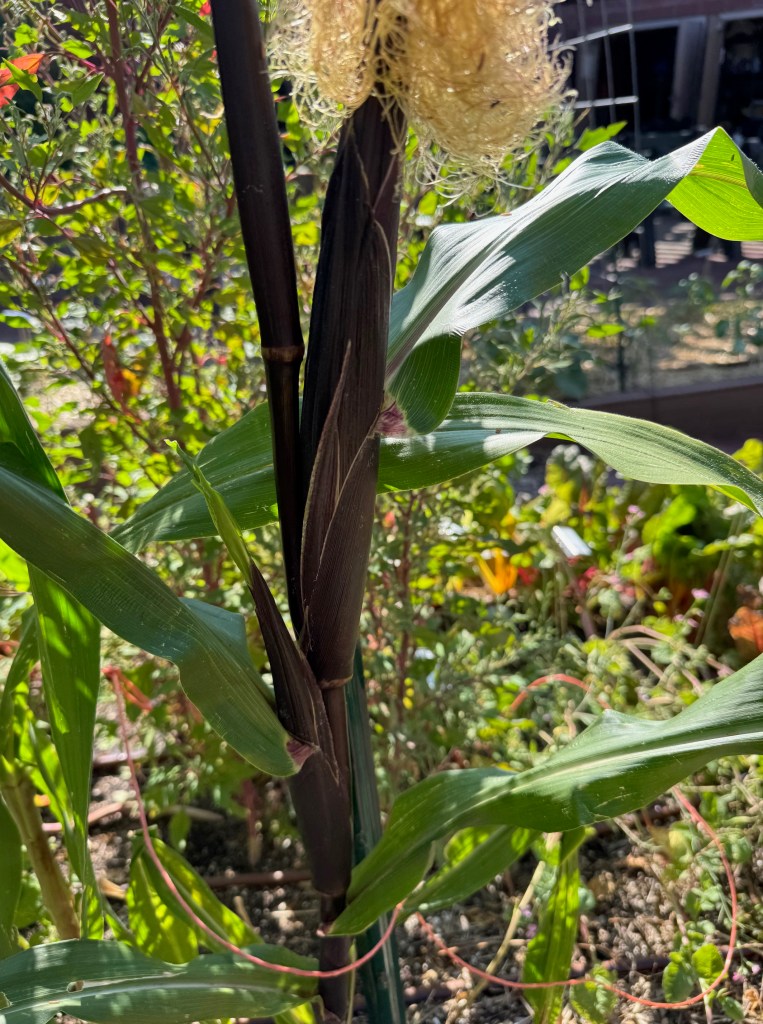
- Seneca Red Stalker, a native corn from the Hudson Valley of New York, is characterized by its dark purple husks. This flint corn is typically grown to be ground or milled to flour after the kernels dry5.
- Japonica Striped Maize Corn, originating in Japan, is also a flint corn and usually consumed after the kernels have dried5.
- Blue Jade Corn is a small savory sweet corn, growing to about 3 feet high. It can be eaten like other sweet corn when kernels are moist and young. Blue Jade can be harvested when kernels are white, whitish blue, and later as they turn to a steel blue5. When compared to supermarket sweet corn, consumers might be a bit surprised by the subtle sweetness of this variety.
Chapter 15 of the Kansas Garden Guide has useful information about sweet corn including harvesting tips. In summary, sweet corn is usually ready to harvest when the ear is full, the juice of kernels is milky when punctured, and the silks are dry at the top of the ear6.
Contributing Writer: Victoria Mosack, Sedgwick County Extension Master Gardener
Thanks for joining us on the Demo Garden Blog! More posts coming soon….
Harvesting Continues
Plant a Row & ICT Food Rescue
Produce from our Demo Garden vegetable harvest is donated to the Sedgwick County Plant a Row (PAR) program and distributed by ICT Food Rescue. There’s more information about PAR and harvest drop-off locations at the Sedgwick County Local Foods website, thanks for your help!
References
- Red Aztec Spinach (Huauzontle). (2025). Ujamaa Seeds, Ujamaa Cooperative Farming Alliance, accessed July 19, 2025, at: https://ujamaaseeds.com/products/huauzontle-red-aztez-spinach
- Huauzontle. (n.d.). World Crops for Northern United States, accessed July 19, 2025, at: https://worldcrops.org/crops/huauzontle/index.html
- Hopi Red Dye Amaranth. (2025). Native Seeds Search, accessed July 21, 2025, at: https://www.nativeseeds.org/pages/hopi-red-dye-amaranth
- Räpple, E. M. (2023). MARCH : ‘Hopi Red Dye’ Amaranth: Amaranthus cruentus ‘Hopi Red Dye’. Santa Fe Botanical Garden, accessed July 21, 2025, at: https://visitsfbg.org/plant-of-the-month-march-2023
- Seed Savers Exchange. (2024). Corn, accessed July 21, 2025, at: https://shop.seedsavers.org/search?keywords=corn
- McMahon, R., Cloyd, R., et al. (2023). Kansas Garden Guide, accessed July 19, 2025 at: https://bookstore.ksre.ksu.edu/pubs/kansas-garden-guide_S51.pdf
 The Demo Garden Blog
Leave a comment