Blog Archives

A Couple of Garden Problems

Looking over the garden this morning after the weekend, I spotted a couple of things going on that will result in replacing a couple of plants around the garden.

This is the first problem I noticed. I saw it when the damage was fresh Saturday morning as well. While it is theoretically possible that there was a weak spot on the stem that the wind snapped, I think that the most likely culprit in this case is a cutworm. Cutworms like to wrap around the stems of young seedlings or transplants and chew them off. That is exactly what this looks like. This pepper plant is done for, at this point. We will be replanting this one tomorrow.

This tomato plant is the worst, although I can see 3 or 4 others with similar symptoms. At first glance, most people would say that the plant is wilting and needs a drink of water. Very tempting response! However, there were three things that made me question that immediate reaction. First, while the plant is wilted, there is no sign of leaf scorch or similar damage that there should have been after the warm weekend. Second, I felt the soil a couple of inches down and in felt moist. If the plant can’t get water out of that soil, then it has some type of root damage, but isn’t yet to the point of scorching. Also, the lower leaves were looking rather yellow, which to me says that the plant has either been getting too much water or it is suffering from too few or too many nutrients.

What I am wondering is if in our concern for keeping the soil moist enough for our germinating seeds, we actually OVER-watered the tomatoes last week. As tempting as it is to put more water on a wilty plant, I’m going to try to hold off the watering and see if they will perk up again. If not, we’ve got some plants in reserve to replace the couple sickly looking plants.

It is theoretically possible that these plants were planted in a localized hot spot due to the compost that we used. I haven’t gotten all the results back yet, but I expect some high numbers. Or…maybe the nitrogen has all been leached out…that also causes yellowing. (But not wilting.) Hmm…

First Insect Pest of the Year

We planted on Tuesday and yesterday morning when I was out in the garden I noticed a few munched on leaves…as well as the culprit:

A dastardly cucumber beetle! Rather, there were several beetles on several different plants. Normally sighting a single beetle on a plant would not trigger the need for spraying. However, on young transplants and seedlings, cucumber beetles can quickly devour the whole plant. I believe that 1 beetle per plant is in fact the “economic threshold” that triggers spraying. (“Economic threshold” is a term for the population level of insects at which there is likely to be an economic loss if treatment is not done. Determining economic thresholds helps farmers know when to spray and when not to waste the time, money, and chemicals. It is an important concept in sustainable agriculture.)

Another reason to spray with only the sighting of a few beetles (with beetles there’s no guarantee you are going to be able to find them all, and they eat a lot quickly!), is that while these guys are currently enjoying our nightshade family veggies (tomatoes, eggplant, peppers), we just planted a whole bunch of different kinds of cucurbits (vine crops – cucumbers, squash, pumpkins, melons, etc.). As the name “cucumber beetle” might suggest, their preferred snack is cucumbers and other vine crops.

Cucumber beetles can make a good dent in the tomatoes and eggplant, but they will eat the entire plant right down to the ground on a newly germinating cucumber or melon. If we can control them now before the cucumbers start to come up, we should be in good shape.

Another reason to spray for cucumber beetles on young vine crops (in case you needed another) is that these early season cucumber beetles have overwintered from last year, and because of that it is possible that they are carrying a disease called Bacterial Wilt that they can transmit to the new crop. Bacterial wilt is NOT a fun disease to have in your melons (and cucumbers, to a lesser extent). As soon as a cucumber beetle vector (one carrying the disease) takes a bite out of your melon plant it transmits the disease. You won’t know it until mid-summer when your vines have nice, unripened fruit on them, and they suddenly collapse in a wilted heap. And there is nothing you can do about it. The only thing you could have done about it was to spray those cucumber beetles in the early season to prevent them from spreading the disease.

Cucumber beetles are one of the prettier vegetable garden insect pests, and I really kind of like them, in a twisted way. However, to my way of thinking, this is one pest that you want to hit with some type of pesticide early, rather than waiting. If you kill off the first generation (the one that may be carrying disease) then you should have a much lower population for the rest of the summer and a much lower risk of bacterial wilt. The worst case scenario would be waiting to control these insects until you have a large population in early to mid-summer that has been passing Bacterial Wilt to the plants, back to the next generation of beetles, infecting more plants, etc.

So what are your spraying options?

Organic Options: Rotenone (organic, but definitely NOT non-toxic), rotenone/pyrethrin combos, pyrethrin, pyrethrin/neem oil combos, neem oil. (This list is from most toxic and most effective to least toxic and least effective.) On a very low population, the neem oil can work okay, but it is a contact spray, which makes it less effective.

Synthetic Options: Permethrin (or pretty much any product that ends in -thrin and is labeled for use on vegetables). This is the synthetic form of pyrethrin/pyrethrum.

Obviously you would choose your spray based on your personal preferences, your willingness to spray multiple times, and your tolerance for insect feeding and other damage. This is a situation where, still several weeks away from any harvest, I would probably use a stronger product in hopes that I only needed to use it once.

Planting Day!

Yesterday was our big planting day in the Demo Garden. Our first planting day in the new garden! Most years we have 2 or 3 days when we do some major planting, but because of the renovation we ended up planting pretty much the entire garden at once. I will say that I am missing all of the colors and textures that the spring vegetables bring to a garden, although we really didn’t have any choice but to focus entirely on summer vegetables this year.

The gals doing the Edible Flowers Garden were so on the ball that they had almost everything planted before I could take more pictures!  Here’s the post with the plan for this garden.

We have a whole bed planned for the cattle panel trellises again this year. Unfortunately, we planned the trellis garden for the landscape paver bed, which is slightly narrower planting space because of the width of the pavers. It makes the space under the trellises narrower and slightly harder to work with. I’m sure it will be fine, but it maybe shouldn’t have been the first choice! Everything in the bed was planted from seed – cucumbers, squash, and melons. Here’s the garden plan if you want to see what we planted.

Here’s a look at the Mexican Garden. We had jicama, Mexican oregano, tomatillos, peppers, and the Red Aztec Spinach ready to transplant. The jicama and some cantaloupe get to fight over the trellis! We also planted black beans and some zucchini. Here’s the map and original post about the plans.

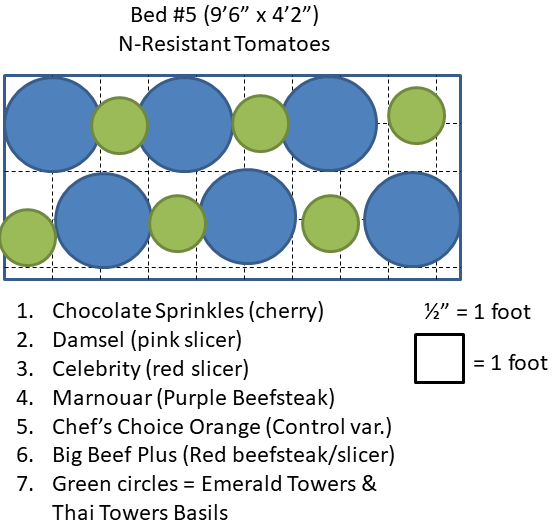
As is tradition, we have an entire raised bed devoted to tomatoes. We are doing the Florida Weave method in half of it and tomato cages in the other half. Although I greatly prefer the Florida Weave method, I think that due to the width of our bed, it is probably not the most efficient use of space with our current layout. Here’s the post about the plans and the varieties we’re growing this year.

Our Family of 4 Garden is smaller this year. It is about 14′ x 4′ as opposed to the 25′ x 4′ that it has been the last few years. We’ll of course take that into account with the dollar amounts we accrue over the season. We’ll also expect lower numbers since we don’t have any spring crops in. Apparently I somehow overlooked writing a post about our plans for the Family of 4 Garden. Here’s a picture of the bed plan:

This is our long plastic lumber bed with the two square second tiers. Half of the bed will be for the Prairie Star Annual Flower trials, and the other half is the Family of 4 Garden. As you can see, we have a pretty limited range of vegetables this year. Green beans, 2 zucchini, 2 cucumbers, 2 tomatoes, and 3 peppers. We should be able to get some fall things in after the beans and maybe after some of the other plants as well.

In the Beautiful Vegetables Garden, the first step was putting up some T posts to use for a bean trellis. We were going to use a wire trellis, but I think they are now planning to use a wire with twine hanging down for the beans. I’ll show more pictures when they get that project done. Meanwhile, here’s the original post with the plans.

I didn’t get an overview picture of the New & Unique Vegetable Garden, but I did take a couple pictures of the Litchi Tomato. It is just starting to develop its prickles, so you can’t really see them yet. I can foresee taking lots of pictures of this cool plant this summer. Here’s the bed plan for the New & Unique Vegetable Garden.

I think that’s it for this round of planting! We still have the 2 herb beds to plant as well as the Prairie Star Annuals (which arrived yesterday afternoon) and some of the containers.


Friday PhotoEssay

I’m going to try my best to get these Friday PhotoEssays up and going for the rest of the spring and summer. This week the theme is “all the non-garden renovation stuff we have going on that I haven’t blogged about yet.”

Our tomatoes, peppers, etc have been growing along in my office. They didn’t grow as well this year until I gave them a hit of fertilizer a couple times last week. They are a little smaller than I’d like for them to be, but I think they’ll be fine to go ahead and plant next week after we get the irrigation lines in place.

I thinned out the red shiso seedlings this week. The seeds were so tiny that we planted several in each pot. However, the plants themselves get pretty big, so I snipped out the excess, leaving a single, healthy seedling.

The roselle (hibiscus) and jicama have been outside getting used to the outdoors since the end of the week last week. They are definitely ready to be planted in their permanent homes.

We planted 3 varieties of hanging basket tomatoes last week (before Herb Day). The 3 varieties are ‘Cherry Falls,’ ‘Red Rambling Stripe,’ and ‘Gold Rambling Stripe.’ They have doubled in size since this picture was taken! I haven’t seen any flowers quite yet, but I’m sure we’ll be at that point soon. They are supposed to be trailing varieties, but thus far they are still pretty upright. Something else to keep an eye on!

I also thinned out the Red Aztec Spinach seedlings last week sometime. Same story as with the shiso. If these seedlings look an awful lot like the common garden weed known as Lambsquarter….that’s because they are both in the Chenopodaciae family. They are cousins! (Hey, we could be growing lambsquarter as an edible green too!)

That’s all I’ve got! We are looking forward to getting our drip irrigation in place on Monday afternoon and then planting like crazy on Tuesday morning. We also have our annual spring Master Gardener Garden Tour coming up a week from now, so there should be lots of posts to look forward to next week. (Or lots of things to come out and see in person if you are in the Wichita area!)

Have a great weekend!

Putting Out Tomatoes

Yeah, we aren’t jumping straight from building the raised beds to planting tomatoes in one day. Sorry, we aren’t that good! However, down inside one of those raised beds is a great place to put some tomatoes that are ready to be hardened off, especially on a cool, blustery, April morning!

Follow

Get every new post delivered to your Inbox.

Join 163 other followers